Your Body and Your Bank Account Run on the Same Operating System
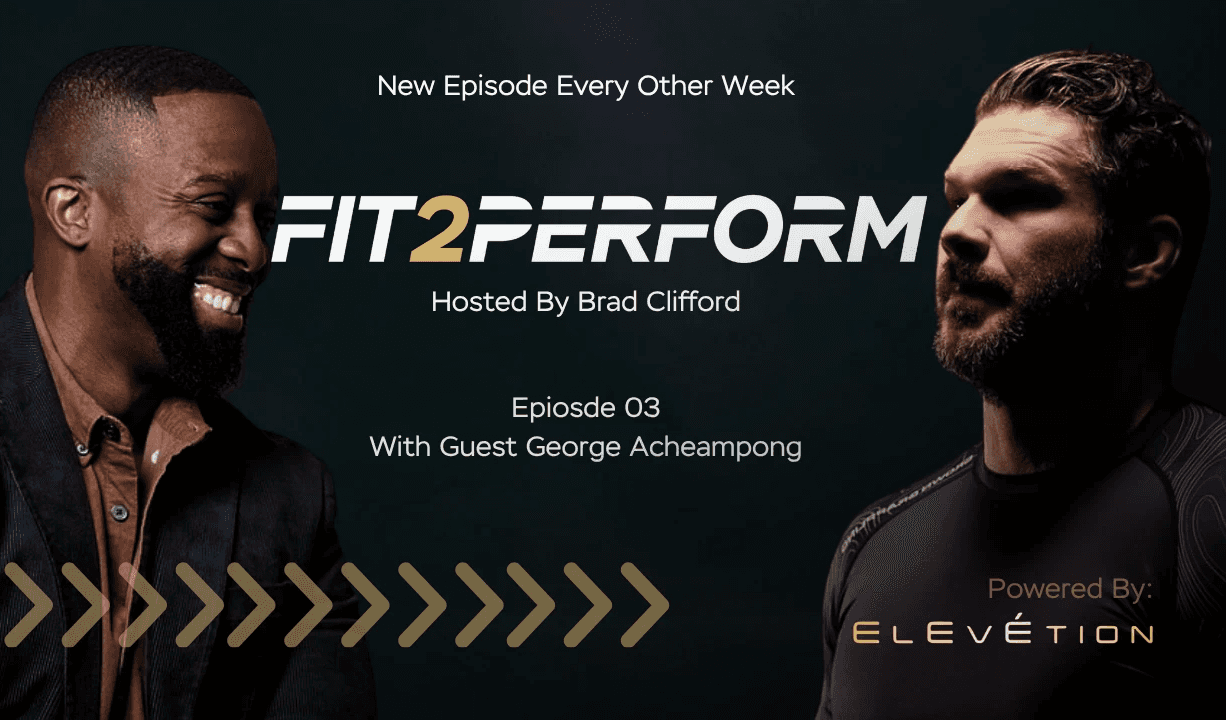
George Acheampong Jr. is someone I'd call a friend before I'd call him a guest, and that's exactly why I wanted him on this show early. He's an Investopedia Top 100 Advisor, a Forbes contributor, and the founder of Melanin Money — but none of that is why our conversation stuck with me. What stuck with me is how identical his framework for building wealth is to everything I teach about building physical capacity. Different vocabulary, same architecture.
The origin story nobody expects
George's mission — helping 100,000 people hit their first million in net worth — didn't start as an ambition. It started in 2016, when he was diagnosed with a giant cell tumor growing in his ninth vertebra, fracturing his spine, days away from potentially attaching to his spinal cord. He was staring down the possibility of paralysis, running a business that was entirely dependent on him personally, and realizing he had no way to leave an impact bigger than himself if that business — and he — disappeared.
That's when the real work started. Not the money part first — the vision part. He researched the racial wealth gap, found projections that Black wealth could hit zero by 2052, and decided to do something about it. The goal started small — help people invest their first thousand dollars — and kept expanding as he hit each target, until it became a mission to close a hundred billion dollars of wealth gap. As of the week we recorded, his clients' aggregate net worth had just crossed a billion dollars. He told me that's what gets him out of bed — not anything he could buy for himself.
Talk to yourself. Don't listen to yourself.
This is the line from George I keep coming back to. Humans are wired to avoid friction, resistance, tension — that's not a character flaw, it's baseline biology. Whatever you actually want is almost always sitting on the other side of some resistance you're naturally inclined to avoid. So the way through isn't tricking yourself into not wanting the donut. George was clear about this: you do want the donut. Lying to yourself about that doesn't work. What works is building a system that keeps what you want most in front of you constantly, so it can compete with what you want in the moment.
He described his own internal reminder — that he wants to be known for leaving a lasting impact on his family and the people he's taught, not for the money itself. That's the thing he goes back to on the days he doesn't feel like doing the podcast, the client call, the marketing. Not vanity. A North Star loud enough to overpower the pull toward comfort.
Massive awareness, massive accountability, massive action
George's three-step framework for getting unstuck applies just as cleanly to a balance sheet as it does to a body composition scan, and he made the connection himself without me prompting it. Step one is massive awareness — actually knowing where you stand. He used the exact analogy I'd use with a client: you know you're overweight, you've been avoiding the scale because you don't want to see the number, but you can't chart a course to anywhere if you don't know your starting position.
Step two is massive accountability — not blaming circumstances, even when circumstances are real and legitimate. He was careful to say nuance exists; some things genuinely are outside your control. But regardless of why you're somewhere, nobody cares more about getting you out of it than you do. Step three is massive action, taken in the direction that vision points, measured against the starting position you were honest about in step one.
What I appreciated is that he didn't stop at motivation. He said discipline matters more than motivation, but what matters most is having a genuinely clear picture of what you want — something specific enough to write down and look at daily, because the brain is built for generating ideas, not storing them reliably. You have to externalize it or you'll lose it to the next distraction.
The Wealth Triangle, and why your body is the same trade
George laid out what he calls the Wealth Triangle: first you make you money — become world-class at a high-income skill. Then you build a scalable business where people and systems make you money instead of trading your hours directly. Then, and only then, you invest the profits into assets where money makes you money. Skill first, then leverage, then compounding. Skip step one and try to diversify immediately, and you're building on nothing.
Where this really landed for me was when he applied the same lens to physical health. His point: you won't live in your house for thirty years, you probably won't drive your car past five, the clothes from last year are already collecting dust — but your body is the one asset you're stuck with for the rest of your life. Whatever you spend on training, on working with a team, on actually optimizing your physiology, is not comparable to a depreciating asset. It's the highest-return investment available to you, and it compounds exactly the way disciplined saving does.
No magic pill, in money or in health
I asked George directly: does a magic pill exist in finance? His answer was immediate — no. And he was blunt about the parallel: the same get-rich-quick fantasy that shows up in personal finance content shows up in fitness and wellness content too. Fast transactional fixes don't exist in either domain. What exists is concentration, consistency, and time — the unglamorous inputs that never trend on social media but are the only thing that's ever actually worked.
That's really the whole conversation in one sentence. Whether you're rebuilding a balance sheet or rebuilding your physiology, the mechanism is identical: get honest about where you are, take ownership of how you got there, and then do the boring, compounding work daily until the results show up. George just happens to be one of the clearest people I've heard explain why that's true.
BACK TO BLOG
GET STARTED